Baseball Articles for the Lexington Herald, 1923
by Albert H. Morehead
----------------------
Lexington Herald, April 15, 1923
DIAMOND CHATTER
ON THE ROOKIE
The rookie works himself to death,
Down South where flowers grow,
He never stops to get his breath,
And never draws up slow.
He bats and chases flies all day,
To please his leader's eye,
And to his lucky gods he'll pray,
That he can pass on by.
He runs himself into a sweat,
He tears the sliding pit,
He swears that he won't gamble, bet,
Or in a card game sit.
He eats no food that makes him fat,
His diet is his care,
He buys the very finest bat,
Of gloves he buys a pair.
He runs around the field at times
When he Is not in use,
And saves his nlckles and his dimes,
Where others cast them loose.
He bangs the ball for all he's worth
And thinks he's going great.
Each night at 9 he seeks his berth—-
He never stays up late.
He doesn't spend his time, in song,
With women, or with wine,
And as the season speeds along,
His work is going fine.
But when the majors cut their men,
No matter what his push,
He sees that he has failed again,
And goes back to the bush.
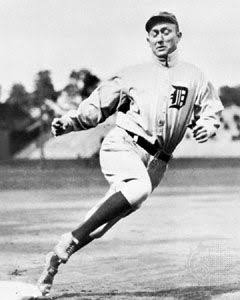
For many years Tyrus Raymond Cobb was the big man of baseball. His wonderful batting, base running and the other qualities which make Cobb the player he is, forced the critics to rank him as the greatest of a time.
He lasted longer even than expected, but still the critics, always fickle, hailed every man who beat him out by a slight margin, as the man who would wear Ty Cobb's shoes. The latest of these Is George Sisler and it is admitted generally that if anyone is worthy to step into Cobb's place, it is the St. Louis first sacker. But still, even a Sisler would have a hard time equalling the records of Cobb.
But now news comes that Sisler will never be the same player, and some rumors imply that he will not be able to take the field again.
Nothing could be worse for Cobb. If Sisler were to play out his life to a natural ending, and then not equal, or break, as the case may be, Cobb's life time figures, there would be something certain. But, with Sisler out of the game, one would have only to guess. Nothing would be proven, and Cobb's leadership would be disputable.
Few would be surprised if there were nothing at all to these reports, and all would be glad if that is so. It would restore to the game the natural leader in all respects, would restore confidence to the St. Louis Browns, and above all, would give the fans more faith.
----------The Cincinnati Reds seem to be the most uncertain club in the National League, at least with the critics. So-called baseball experts don't seem to be able to see the Reds through a telescope at times, although they can't say what's lacking. The Cincinnati team, with the exception of the infield has the strongest team collectively in their circuit. Their outfield, with or without Roush, is one of the strongest in the National League; with Roush, absolutely the best. Their catching staff contains two high class receivers, both gluttons for work. Their pitchers surpass both the Giants' and Pirates' staffs. Their infield is the strongest in the league counting reserve strength, although their first line regulars may not look as good as the Giants "million dollar infield."
Perhaps it is because the team has not been winning consistently from teams of lower rank. True, but they did exactly the same thing in l919, and then, brought home pennant honors. Yes?
----------------------
[Lexington Herald, April 13, 1923]
YOUNGER LADS SHOW UP GOOD
Junior and Model High Baseball Squads Have Promising Material Out for Positions
FAST SLATES ARRANGED
By MOOREHEAD
The past week has been a busy one for the Lexington school baseball teams. From the showings in practice all the teams will be in good condition when they play their first games. The Junior High school team has been showing fine form, and when they play Picadome they will have a good chance of carrying off the honors. Captain Veach has not definitely decided on his line-up, but expects to be able to show the regular team without an exception.
At first is Captain Veach himself. Jack Blevens, "Swope" Loughridge, for second; Anderson and Strothers for shortstop, and Grover Boden for third are other applicants for infield positions. There is a wealth of material from which to choose for the outfield, Miller, McClendon, Gay, Stanley, Johnson and Forsythe being among the fielders. Ferguson and "Sis" Veach are the catchers, while Clark McKinney and Paul Johnson will do most of the pitching.
All of the schedule is not filled, but Manager Hostetter has arranged the following games:
April 13—Picadome at Picadome.
April 17—Athens at Athens.
April 23—Miller School of Business at Woodland Park.
April 27—Open.
May 11—Athens at Lexington.
May 18—Nicholasville at Lexington.
Model High school also has been going through some hard practice, preparing for one of the hardest schedules they have had for many years. The first team is about decided upon. The inner circle will contain Southern at first. Welman at second, Mauser at third and McGuffy at shortstop. The outfield will consist of Giles, Bailey and Nehf, while there are others going out for these positions, who have a chance to make regular places for themselves.
Captain Edmonds to pitch and Thompson to catch will be the battery assignments. Among the others going out are Wren, Moise, Gormly, Willet and Brock.
The schedule follows:
April 13—Paris at Paris.
April 14—M. M. I. at Millersburg.
April 20—North Middletown at North Middletown.
April 27—Ewing at Ewlng.
May 4—Picadome here (tentative).
May 11—Georgetown at Lexington.
May 18—Open date.
May 25—Cynthiana at Cynthiana (tentative).
----------------------
Lexington Herald, April 1, 1923
DIAMOND CHATTER
by SCRIBE
To "Reb" Russell
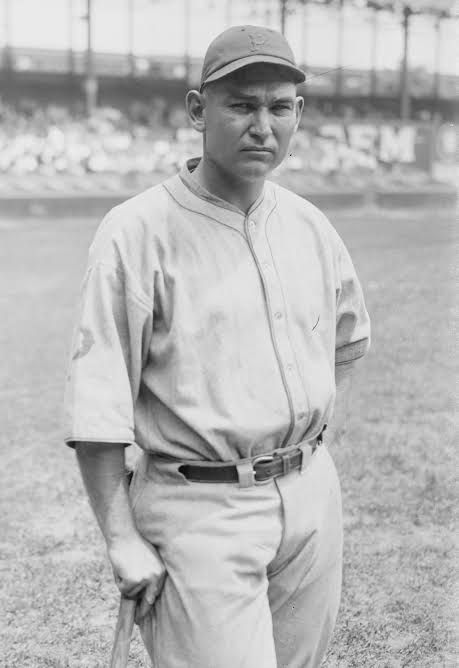
Some years ago Reb Russell was a pitcher very great. The batteries had to hustle or they'd swing an hour late. But Russell had to pass, of course, so what could Gleason do, but in his place a rookie force and think that he was through. But when they shouted him away they made one big mistake. If they'd known what he'd be today they'd given him a stake. But to him the release they gave. Out of the game he passed when not one club refused to waive. All thought he'd played his last.
Some years have gone by and a new name from out the minors comes. A slugging gardener wins fame; all Minnesota hums. His home runs total 33; he ranks high with the stick. Full 16 scouts go down to see him take his lusty lick. But Cantillon was not amiss, from selling he abstained, and so with Minneapolis Reb Russell still remained. Another year goes by. Again he busts them from the lot. Again offers start coming when the pennant race gets hot. The Smoky City gets him and he starts right in to hit. He busts his homers where Ruth fanned, and gives the Babe a fit. Now by the mystic hand of faith again Reb has renown. Once more in balldom he is great, once more he wears a crown.
-----------While the McKinnon's case is raising such a row, with so many different reasons for his release, none of them would-be experts have got it right, according to a letter I received recently from a Cleveland writer.
While, of course, we could not vouch for the truth of this assertion, we readily believe that it was not a question of salary. That the Indians always treat their players fairly is shown by the lack of holdouts in the tribe, and it is certain that if the management had thought that McInnis could have helped the team they would have spared no expense to keep him.
If Stuffy did not like Speaker, it is certain that he could not get along with him, for McInnis is not a man who believes in keeping his personal opinions to himself. Speaker would have been the first man to know that he was disliked, and then Speaker would have had something to say himself. There was sure to be trouble, and, since the owners of the Indians give Spoke complete freedom, it is not surprising that McInnis would go.
Moreover, says he, several other players are at odds with their manager, and it would be no surprise to “those who know” if some more of the prominent players were released or at least traded. Again comes that infallible sign always doubt predictions as to the coming of warm weather. The thermometer may rise up in the skies, the calendar may tell us that it's spring, the almanac may say it is due to become sultry, and we still are dubious. But when instead of the regular camp chatter, the newspaper dispatches show a row of numbers and letters, we know that spring is truly here.
The Dawn of day in The Game
The winter has passed, and the fans have emerged from their sojourn of talk and of papers, of reading the terms in the market of men, and the magnates' big wintry capers. Ere long will the monarchs be treading the turf, with their uniforms spotless and pretty, but longing at length for the day when their clothes will be soiled and their managers fretty. The sphere that has lain so abandoned and still will be bounding with life from the willows, while the rookies will run themselves stiff every morn, at each afternoon stick to their pillows. The gloves and the mitts will be snatched from the shelf, and the satchel bemoan its late tenant, and the pitchers will pitch, and the catchers will catch, and the managers dream of the pennant. One day has departed with several brave and sincere little stabs at position, but the next, oh, of course, though, you never can tell it's all in the fates' disposition. Perhaps in one league Boston swallows the flag, and the Phillies, perhaps, will show color. Maybe this is the liveliest season of all, and perhaps it may finish much duller. Every season the fans have excuses to make and will bet it will ne'er be the same, and in case that they're right then the other fans moan, at the dawn of each day in the game.
----------------------
Lexington Herald, Thursday, April 8, 1923
DIAMOND CHATTER
THE CHANGING TIMES
In nineteen hundred ten and the five years which followed fast,
In looking for St. Louis teams you'd gaze about the last,
The Cards were absolutely punk,
Start as they might, they'd surely flunk.
The Browns grew worse and worse, it seemed, as on the seasons passed.
While this was going on the Eastern teams were winning fame;
The Hub and Quaker City nines won nearly every game.
When Phillies didn't play the Sox
The Braves gave the Athletics knocks,
While many years the Giant team would make its baseball name.
But nowadays, if at the standings you should take a peep,
You'd see the Braves and Red Sox at the bottom of the heap,
With Mackmen down in seventh place,
And Phillies giving Braves a race—
While Browns and Cards, right in the fight, their high positions keep.
When the critics are placing the American League teams as they should finish this year, they gave every club but Boston and Washington a chance for the pennant. No surprise for Boston, of course, but what a fall for Washington.
Last year the Senators were the "dark horse" of the race. New York and Cleveland were to fight it out. and then would come the Browns and Senators.
And it is history that Washington fell down on the job. No reason could be given, except that the team could not hit. With a fine double play combination, perhaps the best baseball has ever known, the best first and second basemen in the league when it came to fielding (for even though Eddie Collins led Sammy Harris, Harris probably should be rated first), and the best all-around infield, they fell way down and were a hopeless second division team all year.
This disappointing showing was attributed in part to the manager, Clyde Milan. With all due respect to Milan, an admirable man, he did not possess the driving qualities which make a good manager, and the team did not work for him.
But why should the team, rather strengthened than weakened, not be conceded a chance this year? Their manager, Donie Bush, certainly has the driving, peppy spirit which Milan lacked. The catching staff, weak last year because of Gharrity's injury, is now the best ln the league as a whole with two good veterans in Gharrity and Ruel, and the two best rookie catchers up in Hargrave and Lapan.
Moreover, the pitching staff is in better condition than ever with Johnson in fine shape and Warmoth and Hollingsworth up, while the infield is strengthened by Joe Evans. The outfield contains Sam Rice, always a star, and "Goose" Goslin, who is, according to a famous baseball scribe, the best left fielder since "Shoeless Joe" Jackson roamed the pastures.
And to make it complete, l think Sammy Harris is destined to become one of the greatest second sackers in the game. Critics, how come?
---------
To Stanley Harris
(With permission of Robert G. Hoenig, for whom the poem was written.)
Before the nineteen hundredth year they mentioned just one name when speaking of the second sacker for the Hall of Fame. The graceful Frenchman, Lajoie, whose agile hands and feet made slow and hard and awkward plays look simple, quick and neat, was placed among the stars of stars, the greatest of them all. But Lajoie, as well as field, could also hit the ball. He either led his league or ranked way high up with the stick. As well as were his hands and feet his batting eye was quick. When Lajoie had passed on by, another came along. In fielding and in base-running was Eddie Collins strong. But Eddie Collins too, like he could field and run, could hit. When he was batting three straight strikes would seldom reach the mitt. And now another second sacker challenges them all. With Sammy Harris in the field, all records take a fall. For little Sammy cannot hit, all he can do is field, and yet before him all the other stars are forced to yield.
----------------------
Sunday, April 8th, 1923
DEVILS START BALL PRACTICE
Coach Downing Forced to Build New Team, But Material on Hand Promises Good Season
TRIEBER LEADS OUTFIT
BY MOOREHEAD
At present all indications point to one of the strongest teams at Lexington High in several years. Several of last year's letter men are out, including Captain Trieber, shortstop and pitcher; Hickey, who will play third this year; “Red” Wilson and others.
The team must step through on its batting and fielding, however, for the pitching is only an imagination and not very vivid at that.
At first base Sidner looks to be a sure bet. Hammersley is much too short to play the initial sack. “Bill” Hickey, one of last year's men, is about as sure, while Trieber going out for pitcher, too, will be seen at short on days when someone else labors on the hill. “Dutch,” by the way, expects to sign up with a Blue Grass League team, preferably Winchester, after the high school season has ended. “Buddy” Smith, erstwhile basketball star, will be seen cavorting at third, while the outfield must be picked from Wilson, who will also pitch; Hardwick, Stokely and Steele, while one or two may force their way into the outer defense.
Crutcher and Maloney are the catchers chosen for first duty, while Cliff Fuller will help Wilson and Trieber on the mound.
The squad has been led along as fast as the weather would permit by Coach Downing, and should be in good shape by April 25, when, according to the present schedule, they will open the season at Georgetown.
The schedule is as follows:
April 25—Georgetown, at Georgetown.
May 4—Flemingsburg, at Flemingsburg.
May 9—Carlisle, at Carlisle.
May 18—Paris, at Paris.
May 21—M. M. I., at M. M. I.
June 1—Clark County High, at Clark County High.
Manager Spicer has not made arrangements for home games, and, therefore, none have been arranged, although one or two teams have been engaged, tentatively.
The other open dates have not been announced and games are open almost any date, away from home.
----------------------
The Lexington Herald, Sunday March 18, 1923
SPORT SCRIBES
By SCRIBE
One Home Run Every 3.14 Games
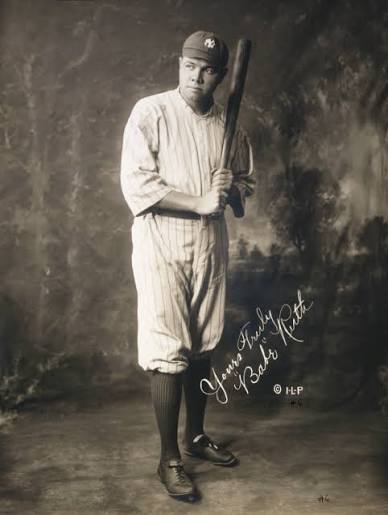
Babe Ruth is through, the knockers say, he's absolutely done. He'll never bat the same old way, and give the fans such fun. He took a step back this last year, and couldn't do a thing. He only hit the air, I hear, when he would take a swing. If he had not been present, why, the Browns would not have come so near passing the Yankees by, and getting in their thumb into the rich World Series cake. They'll put him on the rack, another says, he's Huggins ache, and he will get the sack. But although this is going round and raising such a row in looking up the records sound my views have changed somehow. For George was not an awful mess. He hit the apple much. The figures might have been some less, in homers and the such, but scribes who Hornsby's praises sing have passed these figures by, for figures say that Babe's still king, and figures seldom lie.
Several writers have remarked upon the fact that with the passing of Val Picinich the great Walter Johnson will have no catcher available to receive his tremendous shoots. These scribes should be reminded that unless something unforeseen occurs there is a catcher ready now to hold anything Johnson can command. He is not well known, for he has never made a name for himself in major league ball, and for all that we know perhaps he never will, but he can handle Walter, which is all that is necessary.
As for that none of Johnson's handlers had been really great. “Gabby” Street, who, according to Johnson himself, is the best man ever to receive him, was never an established “star.” Val Picinich was ever a secondrater, and the man of whom I speak, none other than Pete Lapan, may be a coming Schalk, or a dismal failure.
However, if we judge by his record in the minors, Lapan should go big in the American League. In 142 games in the Southern League he hit for the fine average of .335—and the Southern Association is anything but a hitter's league. Only two players who participated in more than one hundred games were better batters than Pete, nor were these far ahead.
---------He was highly touted when he came to the Senators, both as a receiver and batter, and Milan gave him a chance to live up to his reputation in the fall, putting him in a few games, and starting him in one. He did not disappoint his admirers, hitting for more than .400 in 11 games and making several extra base hits. He also caught and threw well, and can well be regarded as one of the coming stars of his league.
His build is certainly not lacking, his arm is strong and sure, and he is a quick thinker, although, of course, he lacks the knowledge of opposing batters with which Schalk, Perkins, and other veterans are blessed. He is fast, something which few catchers are, knows how to run the bases, and is a natural hitter.
He caught Johnson in one full game last fall, and the smoke ball artist declared himself perfectly well satisfied with the youngster. He threw well, hit well, had no passed balls that I know of, and handled Walter's fast balls like a veteran, leaving nothing to be desired.
And so it would seem that Washington's cares in that respect are ended, for a time at least, and Pete Lapan should continue on the Washington team for some years, as Johnson's catcher.
-----------Whether news of Babe Ruth is more valuable to newspapers than other Sporting News, or whether the Babe has a complete line of press agents, the fact remains that he receives more publicity than the rest of the game in all respects.
Ruth stayed at Hot Springs for about two weeks. During that time he had seven different cases of influenza. He sneezed 10 or 12 times, which made a good story, and the scribes were happy. He also must have coughed several times, for he had two distinct cases of bronchitis, and I think he was once threatened with tonsillitis. The scribes were still happy.
But then came a sad day for the sportswriters. Nothing whatever had happened to Ruth all day. He had not even blown his nose, and could not be laid up with a bad cold. He took a hard workout, and then retired to his room for some rest. The writers were puzzled, for they could find nothing that had happened to him.
And so poor Babe had to die. I have never learned just what kind of a death he died. But he died. And—so say the writers—hundreds of telegrams poured in to know whether or not Ruth had died. Perhaps twenty telegrams did “pour” in. I should say that there would have been a few.
This sort of publicity will not help the Babe. If the owners of the Yankees think they can drag Ruth back into public favor by the newspapers they are sadly mistaken. The fans will have to be shown before they will believe, and these newspaper reports only drag the Babe lower in the fans' estimation. When he has come back to where he was two years ago, the fans will believe the old Ruth has returned, and not until then, even though his name was flung out on the headlines of every paper in the country.
-----------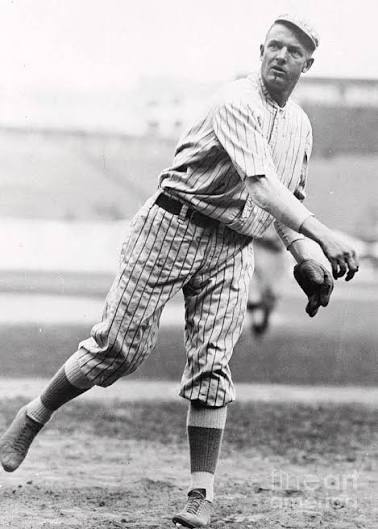
The word is passed from fan to fan that Big Six [Christy Mathewson] has returned. Again to baseball comes that man for whom its heart has yearned. Ambition's realized for him, the greatest of them all. He's now a baseball magnet prim. He's answered balldom's call. This man who won full many a game for little John J. Mac has come back now to gain more fame, and, too, a little jack. Yes, he who many scribes and fans call “greatest of all time” returns again to thrill the stands as in his pitching prime. His pitching was a great success. In winning he ranked high. His managing was no whit less. He passed all others by. So let us hope this pitching gink, as president, don't fail. This new prexy let us drink. To Mathewson! All Hail!